TALKS & KEYNOTES

Where the market brings opinions about the future, I bring data about the present.

Advanced topics. The basics do not set anyone apart.

Keynotes and talks that combine frontier research with global executive practice, to provoke the decisions your organization keeps postponing.

REACH
+20.000

In recent years Edivandro has spoken to more than 20,000 professionals from many countries about technology and AI adoption at world-leading Fortune 500 organizations.
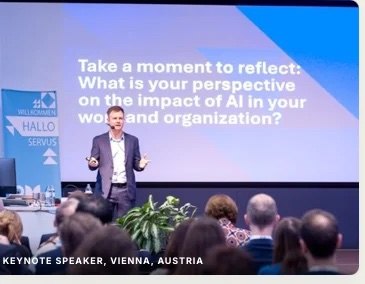
Edivandro Conforto delivering a keynote in Vienna, Austria

Some of the organizations reached by my ideas

I have taken my ideas to international stages and have spoken and taught for tens of thousands of people around the world, communicating complex subjects simply. But what defines my talks is not the reach, it is the method: I do not take the stage merely to talk about trends.

Every topic comes out of research, a product I have built or a transformation I have led, and is designed to provoke.

I believe a good talk ends with an uncomfortable question in the mind of whoever decides. That is what moving between two worlds, science and practice, allows me to do: to provoke with evidence, and to turn discomfort into the motivation to act.

THE 7 COMPETENCIES

Browse the topics by competency

Seven pillars that organize the repertoire. Click a competency to see the matching topics.

OVERVIEW · TOPICS × AUDIENCE

Which audience each topic weighs most for

The intensity shows which audience each topic is strongest for: full colour for the primary audience, light for also relevant. Hover to highlight.

TopicC-level / Exec.Managers / LeadersTeams / SpecialistsCareer (all)
1Productivity with AI
2The end of professions?
3Systems thinking and repertoire
4Deciding without data
5Transformation is constant
6Agility is strategic
7Hybrid organizations (AI + human)
8Strategy dies in execution
9Talent or teams?
10Expertise is not influence
11Managing what does not yet exist
12From research to market
13Improvisation for creativity
1439% of competencies expire
15Do not become irrelevant

Hover (or tap on mobile) over any cell to see how strongly each topic lands with each type of audience.

Primary audience
Also relevant
Not the focus
THE 15 TOPICS

Fifteen topics, seven competencies

Each carries a provocation in the title and the evidence that backs it: a number, a study, a passage lived through. And none is off the shelf: advanced content, examples and depth calibrated for each audience.

AI is surrounded by grand promises and very little real productivity demonstrated by data and evidence, and the distance between buying the technology and actually extracting value from it is now one of the biggest management challenges. In this talk I show why so many AI initiatives never leave the pilot stage, what separates the organizations that measure and get results from those that merely bet, and the path to rethinking processes, roles and decisions. It is the frontier I work on as Chief Science Officer at HiLOOP™, where I developed AI PM Compass™.

Every management audience today carries the same silent question: will my profession survive? I answer with evidence, not futurology: what AI already automates, what it amplifies and what remains irreducibly human, namely judgement, context and decision. It is not the end of professions, it is the end of professions in the form we know them, and those who grasp the difference get ahead. A direct provocation, backed by research and by the practice of someone who builds AI management technology.

The more AI masters specialized knowledge, the more valuable the competency it lacks becomes: seeing the whole system and connecting what appears unconnected. Systems thinking and repertoire, the breadth of someone who moves between disciplines, are what make reinvention possible when today’s specialization becomes tomorrow’s commodity. As a researcher with experience in complex technology and innovation environments, and as an executive who has crossed science, consulting and entrepreneurship, in this talk I show why depth and breadth stopped being opposites, and how to build the repertoire that sustains the reinventions to come.

We live in a time when uncertainty has stopped being the exception and deciding on incomplete information has become the rule. This talk brings together the rigour of the researcher and the experience of someone who has made real business decisions: separating signal from noise, distinguishing reversible from irreversible decisions and why they should be treated differently, and building conviction without falling into overconfidence.

Transformations treated as projects fail, because a project has an end and change, today, no longer does. The organizations that thrive have stopped treating transformation as an event with a start and finish date and have begun treating it as a permanent state: governance that does not stand down, a culture that renews itself and change capability installed as routine. I have led large-scale transformations as an Executive Advisor and as a practice lead at an American multinational, and in this talk I show what changes when transformation stops being a project and becomes a constant, and what it takes to succeed at transformation in the age of artificial intelligence.

After analysing dozens of definitions of agility in the literature and validating a scientific construct, I published the conclusion that underpins this talk: agility is a team competency, not an adjective attached to a method or framework. And it is precisely because it is a competency and not a method that agility becomes strategic: something you develop and sustain, not something you buy with a fashionable framework . A scientifically grounded provocation for organizations tired of transformations that do not deliver.

The false binary between agile and traditional has cost organizations far too much, and the age of AI brings a new hybrid to be designed: that of people and machines. My internationally awarded research on hybrid management models, and the work that followed, shows that deliberate combination outperforms blind adherence to any single approach. The same principle now applies to combining artificial intelligence and human competencies: design, not fashion. In this talk I set out how to design the right model for each context, from management practices to human-AI teams, rather than inheriting one by accident.

Most strategies fail not through poor conception but in the gulf between what is decided in the boardroom and what happens in the operation. I helped conceive a global think tank precisely to attack this problem, and in this talk I bring what I learned along the way: why excellent plans never become results, and what organizations that execute well do differently.

AI promised the “one-person team”, the professional who would single-handedly do the work of many. But a group of talented people has never automatically been a team, and not even the most advanced technology changes what turns individual talent into collective capability. I have built and led high-performing teams, some responsible for deliveries few believed possible. In this talk I address what AI does not replace: trust, psychological safety and ambition as fuel, and why, even in the age of one-person teams, high performance remains collective.

We live in the age of attention: influence has become currency and has come to be confused with knowledge. While deep specialists remain invisible, influencers shape what the public understands as expertise, and deep knowledge, built over years of specialization, loses ground to fast opinion. In this talk I address both sides of that imbalance: why expertise without a voice does not influence, and why influence without substance is not knowledge. Thought leadership is the answer: the discipline of turning real knowledge into recognized authority, with strategy, positioning and presence built through method. I directed exactly this function at global scale. I show how to compete and succeed in the attention game without giving up rigour, both for professionals who want to build their voice and for organizations that want to make deep knowledge a brand asset.

To innovate is to manage what does not yet exist: projects where the path is uncertain, the outcome unpredictable and traditional management approaches do not work. It was the central object of my training as a researcher, from the laboratory to industry, and in this talk I treat research, development and innovation as a discipline, from the paper and sketches where ideas are born (or die) to the portfolio of R&D bets that balances risk and horizon.

Between the idea, the research and the market lies a crossing that kills more technologies than any competitor, and making that crossing is less about science or about market and more about connecting the two. I have lived both sides of that bridge: research, at leading institutions in Brazil and abroad, and market, at an American technology multinational. In this talk I address what makes an idea leave the page and become a real result: knowledge transfer, the meeting of a researcher’s rigour with the urgency of delivery, and the translation between two worlds that speak different languages.

Improvisation looks spontaneous, but it can be deliberately developed. That is what the research I conducted at MIT, published in MIT Sloan Management Review, showed. Among the findings, a number that provokes any audience: teams with an appropriate management approach proved nine times more likely to reach high levels of improvisation (read: creativity). In this talk I present the conditions that turn improvisation into competitive advantage — culture, structure and deliberate practice — well beyond music and theatre.

The figure comes from the World Economic Forum’s Future of Jobs Report 2025: 39% of the core skills required in the labour market are expected to change by 2030. In this talk I unfold that number into strategic questions: what to learn, what to abandon and how to build the habit of “continuous professional reinvention”, before the market decides for you. A provocation for audiences who know that stability, today, is the most dangerous of illusions.

The technology that promises to transform our lives and work can, in the same movement, make you dispensable, if you delegate to it precisely what you should be learning. Long careers are not sustained by inertia but by reinvention on a solid base. My own path has had several distinct acts: researcher, global executive, entrepreneur, and back to entrepreneurship. In this talk I share what each crossing teaches about the second and third acts of a career, and how to turn accumulated experience into an asset instead of automating yourself out of the game.

Bespoke topics. Beyond these, new titles are designed from the same repertoire of research and experience, according to the audience and the event.

FORMATS

Three ways of reaching the audience

Always live, with room for questions, in Portuguese or in English.

In person

The classic keynote format: on the stage of your event, convention or conference, in Brazil or abroad. It is where presence, narrative and provocation work at full power.

Live virtual

A live broadcast for distributed teams, online events and global gatherings, with the same interaction and room for questions, with no boundaries of location.

Hybrid

The in-person event with simultaneous broadcast to remote audiences, joining the energy of the stage to the reach of the virtual.

Typically 45 to 60 minutes, with room for questions, adaptable to the design of the event. Also available for panels, moderated interviews and conversations with leadership teams.

AUDIENCES AND EVENTS

For every audience

Four types of audience and event, with the language calibrated for each, from the technical team to the C-suite.

Corporate events

Kickoffs, annual conventions, leadership gatherings.

Industry congresses and professional associations

Keynotes, roundtables, fireside chats.

Innovation and R&D gatherings

Technical audiences from engineering, manufacturing and research.

Universities and business schools

Inaugural lectures, graduations and academic events.

FREQUENTLY ASKED QUESTIONS

What people usually ask

The typical format is 45 to 60 minutes, with additional room for questions and answers. The duration adapts to the design of the event.

Both, and hybrid as well. The in-person keynote can take place anywhere, in Brazil or abroad; live virtual serves teams and events anywhere; and hybrid joins the stage to a simultaneous broadcast.

In Portuguese or in English, according to the audience of the event.

Always. No talk is off the shelf: the topic is calibrated to the sector, to where the organization stands and to the profile of the audience, and new titles can be designed to order from the same repertoire of research and experience.

From leadership conventions and corporate events to industry congresses, innovation and R&D gatherings, professional associations, universities and business schools. The language is calibrated for each audience, from the technical team to the C-suite.

Yes. I have spoken on international stages for years, in Portuguese and in English, and the virtual format removes any boundary.

Yes, and that is usually where the impact multiplies. The talk can form part of a development programme, advisory work or consulting projects, before or after the event.

The conditions for recording and internal use of the content are agreed case by case, in the proposal.

Official biography, high-resolution photographs and a synopsis of the topic for the event communications.

As soon as the event date is set. The diary is organized months ahead, and popular dates go first.

Fees vary according to format, location, language and level of tailoring. Request a proposal with the date, city and estimated audience for the event.

Bring to your stage a provocation that ends in a decision.

Invite me to an event