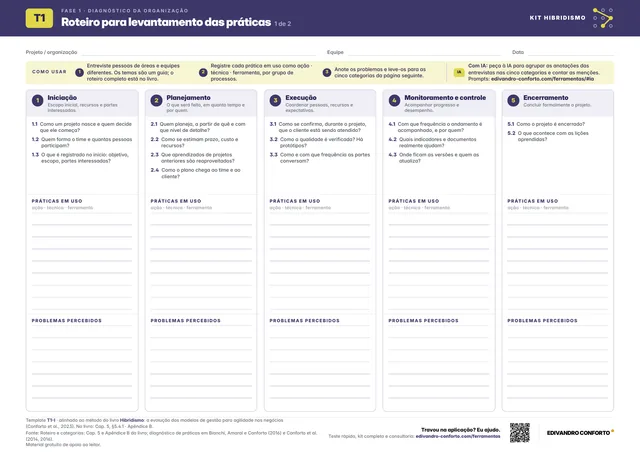
T1
Practice survey guide
Interviews to map the practices in use and the problems of the current model.
PDF · 2 pp. · 147 KBIn the kit
Find out in 2 minutes whether your project calls for predictability, adaptation or a combination of both. Then use the 8 templates aligned with the method of the book Hibridismo, plus an AI supplement, to build the model with your team.
6 questions in 2 minutes, or the full diagnostic with 26. Instant result, with a link for your team. Start
The 8 method templates, plus the AI supplement, as a PDF in your inbox. Get it
Stuck choosing practices or implementing them? This is where I come in. Let’s talk
Think of a concrete project, the one you are running now or the next one. The questions are based on the book’s Hybrid Model Customization Questionnaire: six for a first snapshot, or all 26 for the full diagnostic, with the 13 indices calculated instantly. And now you can see how projects similar to yours worked.
For each question, choose from 1 to 6: the closer to 1, the more you recognize yourself in the description on the left; the closer to 6, in the one on the right. The result appears instantly, with a comparison with similar projects, and becomes a link you can share with your team. The quick test requires no sign-up; the full diagnostic only asks for your email to show the result.
Adapted from the book Hibridismo (Atlas/GEN, 2023, in Portuguese) and the diagnostic tool by Bianchi, Conforto and Amaral (2021, IJMPB), with the questions summarized. The full wording and the original scales are in the book. Comparison and points to watch: international benchmarks and data collected over more than a decade of research and consulting projects, always as aggregate figures.
Not part of the score: it adjusts how the result is read, the AI prompt and which similar projects you are compared with.
For R&D and innovation, maturity changes the reading: research calls for adaptation in scope and risks; close to scale, quality and costs pull toward anticipation.
Before the 26 questions come 4 about the product: outsourcing, risk to people, priority and use of AI. Regulation and interdependence come from questions 17 and 4, only when the answer is at the extreme.
1–2
5–6
Linked to your answers. Each one says where it comes from: seen in diagnostics from consulting work, or a rule of the method from the book.
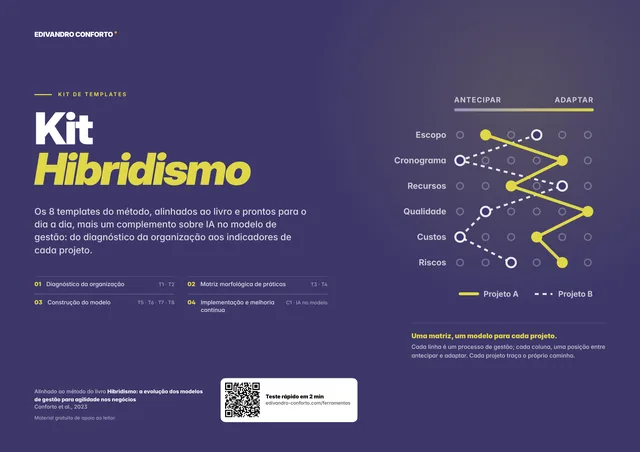
The method of the book Hibridismo shifts the focus away from the “ready-made model” and onto the customization process. Each template feeds the next, and the same scale, from anticipation to adaptation, connects them all. The templates in this kit are aligned with the method, redesigned for day-to-day use.
14-page PDF (923 KB): cover, how to use, scientific basis, the 8 templates and supplement C1, in A4 landscape (print on A3 to use with sticky notes). Each page indicates the reference chapter of the book and includes a tip for working with AI.
Interviews to map the practices in use and the problems of the current model.
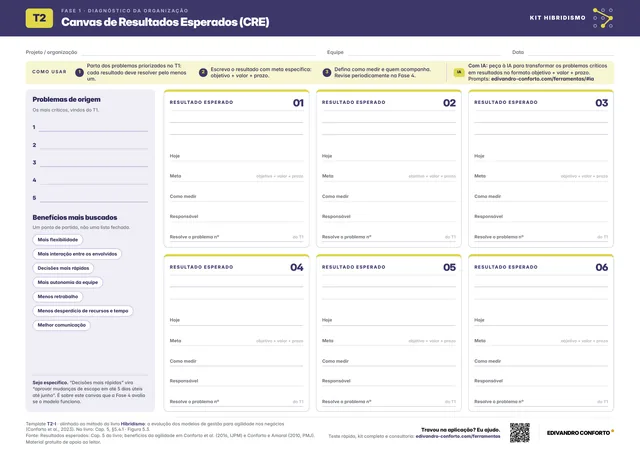
What needs to change, with targets in the objective + value + deadline format.
Interview people from different areas and teams. The diagnosis is only worthwhile if it sees the whole organization, not just the view of whoever runs the project.
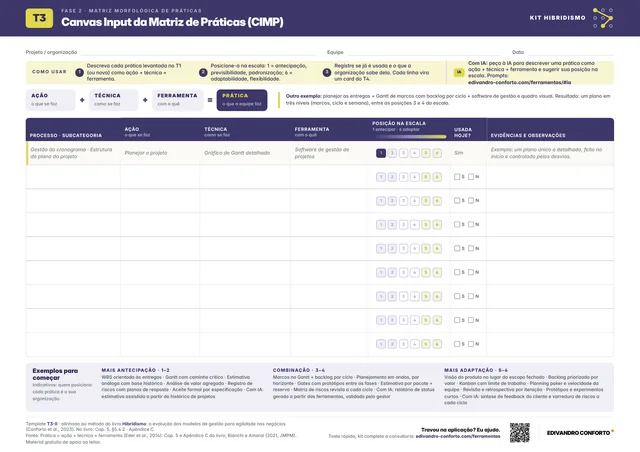
Each practice as action + technique + tool, positioned on the scale.
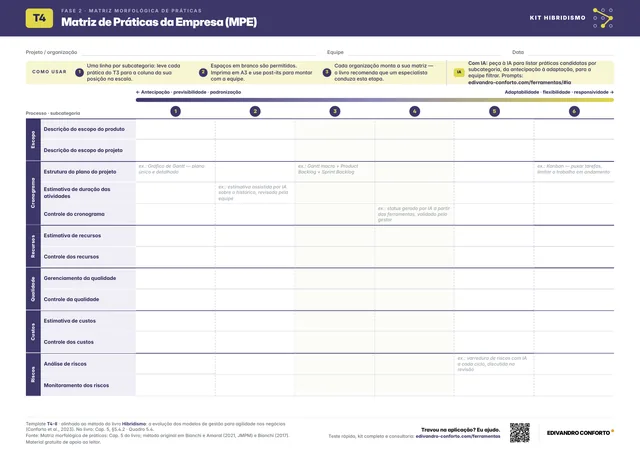
The organization’s menu of practices, from anticipation to adaptation.
The company matrix should be built by a specialist. It defines which practices are valid in your organization and prevents each project from reinventing the method.
Want support at this stage? Let’s talk →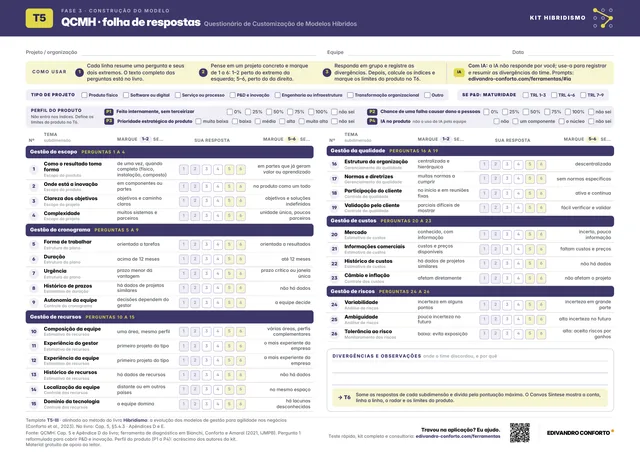
The 26 questionnaire topics and the 4 product questions on one sheet, to answer as a group and record disagreements.
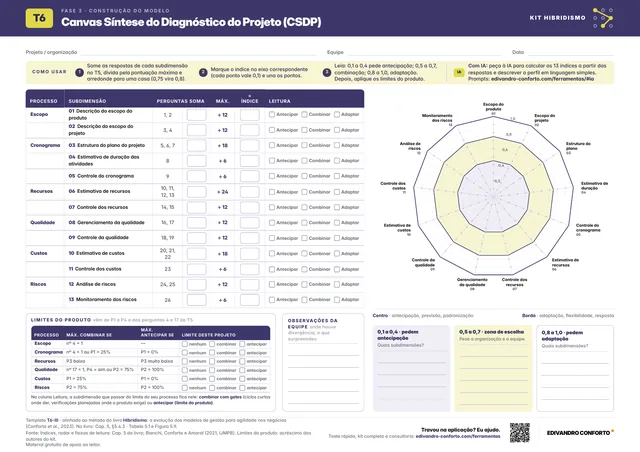
Indices by sub-dimension, product limits and the project radar to draw by hand.
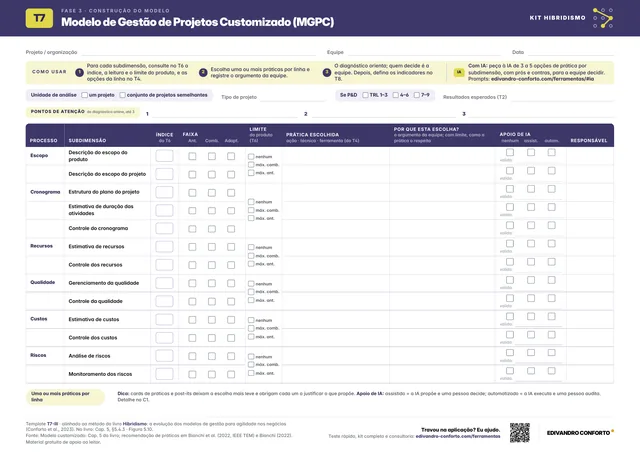
The chosen practices, line by line, with the team’s reasoning.
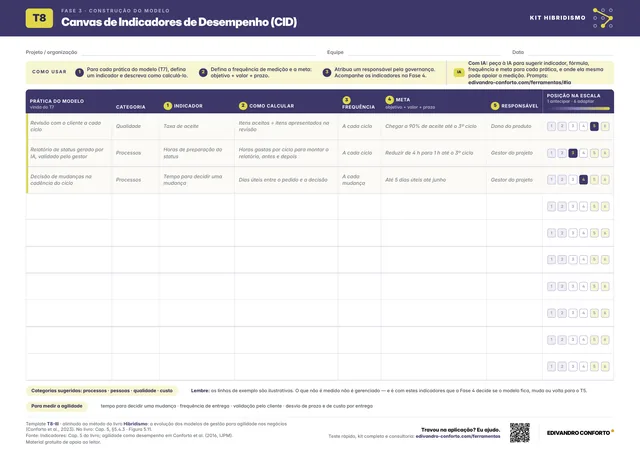
Indicator, calculation, frequency, target and owner for each practice.
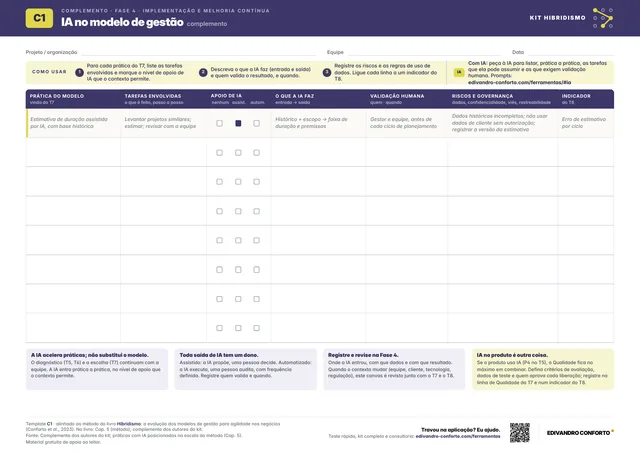
Supplement: for each practice, what AI does, who validates, risks and governance.
Hybrid management is behavior, not paperwork. Use the T8 indicators and the T2 targets to decide whether the model stays, changes or goes back to the diagnosis (T5) whenever the context changes: team, client, technology or regulation. C1 records, practice by practice, what AI does and who validates.
Copy, paste into ChatGPT, Claude or your company’s Copilot, and add what the team filled in on the template. AI organizes, proposes and questions; the team is still the one who decides. In the templates, each page carries the corresponding “With AI” tip.
You are an expert in hybrid project management models. Below are interview notes on practices in use and problems perceived in an organization. Group the problems into the five categories of the method (culture and leadership; processes and procedures; teamwork; knowledge and learning; communication), count the mentions per category, point out the 3 most critical problems and explain the criterion.

[paste the T1 notes here]
For each of the problems below, propose an expected result in the objective + value + deadline format, how to measure it and a suggested owner. Avoid generic phrases such as "faster decisions": be specific and measurable.

[paste the 3 critical problems from T1 here]
Describe the management practice below in the format action (what is done) + technique (how it is done) + tool (with what). Then suggest its position on a scale from 1 (anticipation, predictability, standardization) to 6 (adaptation, flexibility, responsiveness) and justify it in two sentences.

Practice: [describe how the team does it today]
Below are answers from 1 to 6 to a 26-question questionnaire, grouped into 13 sub-dimensions. For each sub-dimension, add up the answers, divide by the maximum score (6 × number of questions) and round to one decimal place (0.75 becomes 0.8). Classify: 0.1 to 0.4 calls for anticipation; 0.5 to 0.7, combination; 0.8 to 1.0, adaptation. Then describe the project profile in plain language and point out where it contradicts itself.

[paste the T5 answers here, question by question]
In a project diagnosis, the sub-dimension "[name]" scored an index of [0.0 to 1.0] on the scale from 1 (anticipation) to 6 (adaptation). List 3 to 5 candidate practices in the action + technique + tool format, position each one on the scale, say in which context it works and what it requires from the team. Include at least one AI-supported option and say what it automates and what still depends on people.

Project context: [describe]
For each practice below, suggest an indicator, the calculation formula, the measurement frequency, a target in the objective + value + deadline format and an owner. Also point out where AI can support the collection or analysis of the indicator and where human validation is needed.

[paste the T7 practices here]
Below are the diagnostic results for the same project answered by several people on the team (each block has the person’s name and the indices by process or sub-dimension, from 0 to 1: 0.1 to 0.4 calls for anticipation; 0.5 to 0.7, combination; 0.8 to 1.0, adaptation). Build a table comparing the people, point out where there is consensus and where disagreement is greatest, raise hypotheses about the reason for each disagreement (role, area, experience) and propose 3 questions for the team to discuss before choosing the practices.

[paste the results here: one block per person, copied from each person’s screen or PDF]
The book itself is direct: the organization’s practice matrix should be built by a specialist. These are the three points where most teams get stuck, and where I come in.
Which practices are valid in your organization, and where on the scale? Without this curation, every project reinvents the method and fads win.
Scope calls for flexibility, costs call for control, regulation calls for gates. The index guides; the decision requires context, culture and experience.
Hybrid management is behavior, not paperwork: indicators, rituals and a review of the model whenever the context changes.
A frank conversation about the management model of your project or portfolio. No commitment.
The book’s method applied with your team: questionnaire, company practice matrix and reading of the diagnosis.
From the designed model to implementation, with reviews whenever the context changes.

A evolução dos modelos de gestão para agilidade nos negócios (The evolution of management models for business agility)
How to balance predictability and adaptability by choosing the right practices for each context: no dogma, with method. The book presents the principles of hybrid management, the four-phase method with the eight original templates, the 26 questions in full with their scales, the complete practice matrix and a real case, from diagnosis to final model, in an autonomous drone project. The kit is the instrument; the book is the method explained. Published in Portuguese.
The method grew out of a line of research started at EESC-USP and continued at MIT. These are the authors’ publications that support each part of the kit. Each template indicates the corresponding source in its footer.